
In an environment where ERP systems concentrate almost all of the company's sensitive data, including financial, HR, purchasing, and production data, SAP access security is no longer an option.’SAP audit has established itself as a mandatory step for any organization wishing to control its risks, meet regulatory requirements, and preserve the integrity of its business processes.
Yet, many companies still approach SAP audits with a vague vision: is it a technical check? A compliance initiative? An exercise imposed by external auditors? The reality is richer – and more strategic.
This guide aims to give you a clear and operational vision of what a SAP audit truly is, why it is indispensable, how it is conducted concretely, and what results you can, and should, expect from it.
The key takeaways:
- A SAP audit Analyze the access rights, segregation of duties (SoD), and regulatory compliance of your SAP environment.
- It is essential for prevent internal fraud, respond to requirements SOX, GDPR, or ISO 27001, and master the technical debt accumulated on your roles.
- A A well-conducted audit takes place in 5 steps Scope, authorization extraction and analysis, risk assessment, remediation plan, reporting and monitoring.
- It does not require No production interruption and mobilize your teams on an ad hoc and structured basis.
- Ad hoc audit and Continuous control (GRC) complementary: one cleans the existing, the other maintains the level of security over time.
- Ideally, an SAP audit is performed every 1 to 2 years, and systematically before an S/4HANA migration or an external audit.
What is an SAP audit?
A SAP audit is a structured analysis approach aimed at evaluating the security, compliance, and effectiveness of your SAP environment. It primarily focuses on three dimensions:
Permissions and access rights. Who can do what in the system? Are the SAP profiles and roles correctly defined, assigned, and documented? Are there excessive access rights or dangerous combinations of authorizations?
Segregation of Duties (SoD). Do some users accumulate incompatible rights? For example, can the same employee both create a vendor and approve a payment? These conflicts represent a major internal fraud risk.
Regulatory compliance. Does your SAP system meet the requirements of standards such as SOX (Sarbanes-Oxley), GDPR, ISO 27001, or the recommendations of ANSSI? Are audit trails activated and retained?
SAP audits can be conducted in External audit preparation (statutory auditors, SOX auditors, ISO certification), but it can also be initiated proactively, like a periodic system health check.
Why has SAP auditing become indispensable?
The exhibition space has expanded considerably.
With the multiplication of deployed SAP modules (FI, CO, MM, SD, HCM, PP...), the number of users, the connection to third-party systems, and the opening to cloud environments (SAP S/4HANA, SAP BTP), the vulnerability points have multiplied. A misconfigured right in a single role can open a breach in the entire value chain.
Regulatory pressure is intensifying
Publicly traded companies subject to SOX must prove that their internal controls over financial reporting are reliable, which directly involves SAP access management. Similarly, GDPR requires justification of who has access to personal data and why. Regular SAP audits are a direct response to these obligations.
Technical debt accumulates silently
In many organizations, SAP roles have evolved over the years without clear governance: rights have been granted for specific needs, profiles have been copied without being cleaned up, and employees who have left the company retain active access. This accumulation of technical debt creates fertile ground for security incidents and non-compliance.
Internal fraud remains an underestimated reality
According to industry studies, a significant portion of corporate fraud is facilitated by uncontrolled access rights accumulation in ERP systems. SAP auditing is precisely the tool that allows these vulnerabilities to be detected before they are exploited.
The 5 steps of a well-conducted SAP audit
A rigorous SAP audit cannot be improvised. Here is the method we apply at Secureway, forged over more than 17 years of hands-on experience with clients of all sizes and from all sectors.
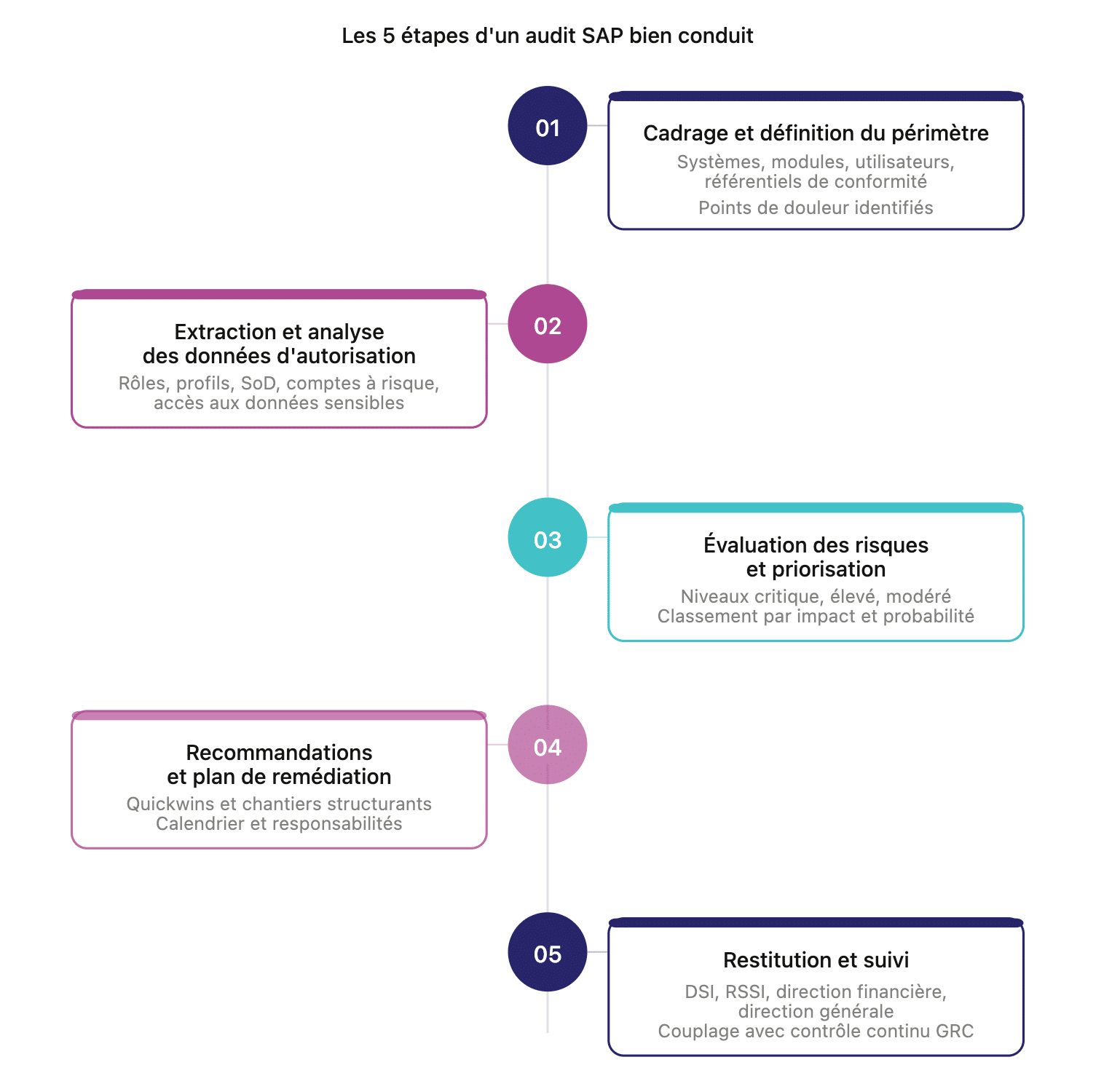
Step 1 — Framing and Scope Definition
Before analyzing anything, we must precisely define what will be audited. Which SAP systems are concerned (ECC, S/4HANA, BW, GRC…)? Which modules? Which types of users? Which compliance frameworks apply?
This framing phase is also an opportunity to identify the pain points already known to the teams: problematic access, alerts raised by auditors during the last audit, recent departures that were not properly handled.
An SAP audit without a clear framework risks getting lost in the details and missing real risks. It is the foundation of the entire process.
Step 2 — Extraction and Analysis of Authorization Data
This step is the technical core of the audit. Using specialized tools—whether native SAP transactions (SUIM, SU10, SE16…), third-party analysis tools, or dedicated solutions like SWAWE Compliance Companion — the auditors extract all data relating to roles, profiles, and authorizations.
The analysis focuses on several axes:
- Role mapping: What roles exist, how are they structured (simple roles, composite roles), and are they documented?
- Assignment analysis: Who has what? Are there users with SAP_ALL rights or excessive generic profiles?
- SoD conflict detection: From a risk matrix, we identify incompatible combinations of rights held by the same user.
- Risk accounts Generic users, service accounts, untracked emergency (Firefighter) accounts.
- Access to sensitive data: Who can access payroll data, vendor banking data, and critical system settings?
Step 3 — Risk Assessment and Prioritization
Not all detected anomalies are equal. A good SAP audit doesn't just produce an exhaustive list of non-conformities: it prioritizes them class by criticality level based on their likelihood of exploitation and their potential impact.
There are generally three levels:
- Critique: risk of direct fraud or system compromise (e.g., a user can alter accounting data without checks)
- Raised risk of regulatory non-compliance or access to sensitive data without justification
- Moderate to low: deviations from best practices to be corrected as part of a continuous improvement process
This prioritization is essential for directing remediation actions towards what truly matters.
Step 4 — Recommendations and Remediation Plan
An audit is only valuable if it leads to concrete actions. For each identified risk, the auditor must propose a precise, realistic, and prioritized recommendation.
There are two types of actions:
- Quick wins: high-impact quick actions, such as deleting obsolete access, revoking SAP_ALL rights, and disabling inactive accounts.
- Structuring projects Redesign of a roles model, implementation of a GRC solution, definition of an emergency access management policy.
The remediation plan must be accompanied by a realistic timeline and a clear division of responsibilities among the SAP teams, the IT department, the financial management, and the business stakeholders.
Step 5 — Return and Follow-up
A The SAP audit concludes with a formal report. To stakeholders: CIO, Finance Department, CISO, General Management. This presentation must be accessible – not just technical – so that decision-makers understand the stakes and commit to the correction process.
Post-audit follow-up is just as important. Have the identified risks been corrected? Are the measures put in place sustainable over time? This is why we systematically recommend coupling point-in-time audits with a continuous assessment, through a GRC solution that continuously monitors access compliance.
What an SAP audit reveals in concrete terms
After hundreds of SAP audits conducted since 2007, here are the findings we make most frequently:
Ghost users. Accounts belonging to employees who left months ago — sometimes years ago — with active rights still in place. These accounts represent an open door for malicious actors or disgruntled former employees.
SAP_ALL or equivalent rights granted too broadly. This profile, which grants access to almost all SAP functions, is sometimes granted «provisionally» and never revoked. It constitutes a maximum risk.
Unmaintained SoD matrices. Many organizations have defined a segregation of duties matrix at some point and then failed to update it as their systems and business processes evolved.
Insufficient documentation. The roles were created by consultants, sometimes without documentation, making it difficult to understand what each role actually allows.
Untraced emergency access (Firefighter). These exceptional accesses, necessary for certain critical operations, must be subject to strict control. Without traceability, they become an uncontrollable blind spot.
Expected results of an SAP audit
A well-executed SAP audit produces tangible and measurable benefits:
A significant reduction in the risk surface. By removing excessive access and correcting SoD conflicts, you mechanically reduce opportunities for fraud and attack vectors.
Better external audit preparation. Organizations that have conducted a prior internal audit approach SOX audits, statutory audits, or ISO certifications with much greater serenity—and achieve better results.
Demonstrated regulatory compliance. You have formalized documentation, access traceability, and a history of corrective actions, all elements expected by regulators.
Better long-term access governance. The audit is often the starting point of a deeper transformation: defining a role management policy, implementing a periodic access review process, and integrating a GRC solution for continuous control.
An operational performance gain. Better defined SAP roles also mean fewer «I need access to do this» tickets, fewer improvised workarounds, and teams working in a clearer, more consistent environment.
When should an SAP audit be triggered?
Some triggers are obvious:
- Before or after an SAP migration (Transition to S/4HANA, version change)
- Following a security incident or a suspicion of fraud
- In preparation for an external audit (SOX, ISO certification, auditor review)
- After a merger and acquisition, to harmonize environments and rights
Others are less visible but just as relevant:
- After a fort turnover in user or IT teams
- After several years without a review roles and permissions
- During a reorganization leading to changes in functional areas
In practice, we recommend not waiting for a critical trigger. A proactive SAP audit, conducted every one to two years, helps prevent the accumulation of technical debt and maintains a satisfactory level of security at all times.
Spot audit or continuous monitoring: which approach to choose?
The spot audit is a snapshot at a specific moment: it identifies existing risks and proposes corrections. It is an essential approach, but insufficient on its own.
Visit continuous assessment, implemented via a GRC solution like SAP GRC Access Control or SWAVE Compliance Companion, continuously monitors access compliance and triggers alerts as soon as a risk appears. It prevents drift rather than detecting it after the fact.
The combination of both approaches is the most robust strategy.
- On-demand audit to clean up the existing situation and establish a healthy baseline
- Continuous monitoring to maintain this level of security over time
Conclusion: SAP Audit, a Strategic Investment
L’SAP audit is not a constraint suffered — it is a strategic lever to regain control of your information system, reduce your risks, and strengthen the trust of your internal and external stakeholders.
When managed well, it reveals often unsuspected vulnerabilities, structures sustainable access governance, and prepares your organization for upcoming regulatory challenges.
At Secureway, we've been supporting companies in this endeavor since 2007, with a proven methodology and in-depth knowledge of SAP environments in all their diversity: ECC, S/4HANA, GRC, Fiori. Our goal is not to produce another report, but to help you build sustainable SAP security aligned with your real business challenges.
Would you like to assess the security maturity of your SAP environment? Contact our experts for a no-obligation initial consultation.
FAQ : Frequently asked questions about SAP auditing
What is the average duration of an SAP audit?
The duration varies depending on the scope and complexity of the environment. For a mid-sized organization (200 to 500 SAP users, 3 to 5 modules), generally count Between 3 and 6 weeks from start to finish : from the framing phase to the final delivery, including data extraction and analysis. For large multi-site or multi-system environments (several thousand users, numerous tenants), the duration can extend to 2 or 3 months. Conversely, a targeted audit on a restricted scope—a single module, a specific SoD risk—can be completed in a few days. The key is not to sacrifice the depth of analysis for speed: a superficial audit gives a false sense of security, which is worse than no audit at all.
What is the difference between an SAP audit and an audit conducted by statutory auditors?
These are two complementary approaches, but of a very different nature. The statutory auditors' audit is a Financial audit It aims to certify the reliability of financial statements. Auditors are interested in SAP insofar as the system produces financial data—they will notably check that IT General Controls are in place. However, they neither have the mission nor the tools to deeply analyze the granularity of SAP roles, SoD conflicts at the transaction level, or the consistency of the authorization model.
L’Specialized SAP audit, he goes into precisely that level of detail. It is led by SAP system experts who are familiar with authorization logic, authorization objects, sensitive transactions, and risk patterns. The two audits feed into each other: a rigorous SAP audit prepares and secures the transition for the external auditor's review.
Should SAP production be interrupted during the audit?
No. A well-conducted SAP audit is a non-intrusive approach which requires no service interruption. The bulk of the work involves read-only data extraction—authorization reports, role lists, activity logs—without any modifications to the production system. The only times that require some availability from your teams are the scoping interviews and the final deliverable. This is indeed one of the advantages of SAP audits over other types of technical audits: they can be carried out in parallel with regular operational activities, without disrupting users' daily routines.
The following teams should be involved in an SAP audit: * **Internal Audit Team:** This team is responsible for planning, executing, and reporting on the audit. They will work closely with the business and IT teams to understand the processes and controls. * **Business Process Owners:** These are individuals who have a deep understanding of specific business processes (e.g., finance, procurement, sales). They will provide insights into how the SAP system supports these processes and what controls are in place. * **IT Department (SAP Basis Team, Security Team, Application Support):** * **SAP Basis Team:** Responsible for the technical infrastructure of SAP, including system configuration, performance, and availability. They will provide information on system architecture, transports, and system logs. * **SAP Security Team:** Responsible for user access, roles, authorizations, and segregation of duties within SAP. They will provide data on user profiles, role assignments, and security configurations. * **SAP Application Support Team:** Responsible for the functional aspects of specific SAP modules. They can explain how certain functionalities are configured and used. * **Financial Department (if the audit has a financial scope):** This team is crucial for understanding financial controls, reporting, and compliance requirements. * **Compliance or Legal Department:** Involved if the audit has regulatory or compliance implications (e.g., SOX, GDPR). * **External Auditors (if applicable):** If the audit is part of external financial statement audits, the external audit firm will also be involved. * **Subject Matter Experts (SMEs):** Depending on the specific areas being audited, you may need to involve SMEs from various functional areas (e.g., supply chain, HR). * **Project Management Office (PMO) (if relevant):** If the audit is related to a specific SAP project implementation or change, the PMO might be involved.
An SAP audit involves several stakeholders, to varying degrees depending on the phase:
The SAP Basis and Security Team is the most sought-after: it provides the necessary access for data extraction and answers technical questions about system configuration.
Business correspondents (Finance managers, purchasing managers, HR managers, etc.) are consulted to validate the relevance of roles to actual duties performed. They are the ones who can confirm or deny whether a right is justified or excessive.
The IT department and the CISO are involved in the framing and reporting, as the audit directly impacts IT security policy.
Financial management or internal control, especially in a SOX or certification context, closely follow up on the results and the remediation plan.
In practice, an SAP audit does not require these teams full-time: it involves structured, spaced-out points of contact with reasonable time investment from each party.
Is a SAP audit relevant if we don't have a GRC solution yet?
Absolutely, and it's often the best starting point. The absence of a GRC solution generally means that no automated controls have been put in place for access, making the audit even more necessary to get a real picture of the existing setup.
The SAP audit can also be the natural trigger for a GRC project: once risks are identified and quantified, it becomes much easier to justify the investment in a continuous control solution like SAP GRC Access Control or SWAWE Compliance Companion. The audit provides the baseline — the current state — from which the GRC solution will take over to monitor and prevent deviations over time. The two approaches are therefore complementary, and one logically prepares for the other.